
 English
 中文简体
中文简体
Engineering Under-Vehicle Protection
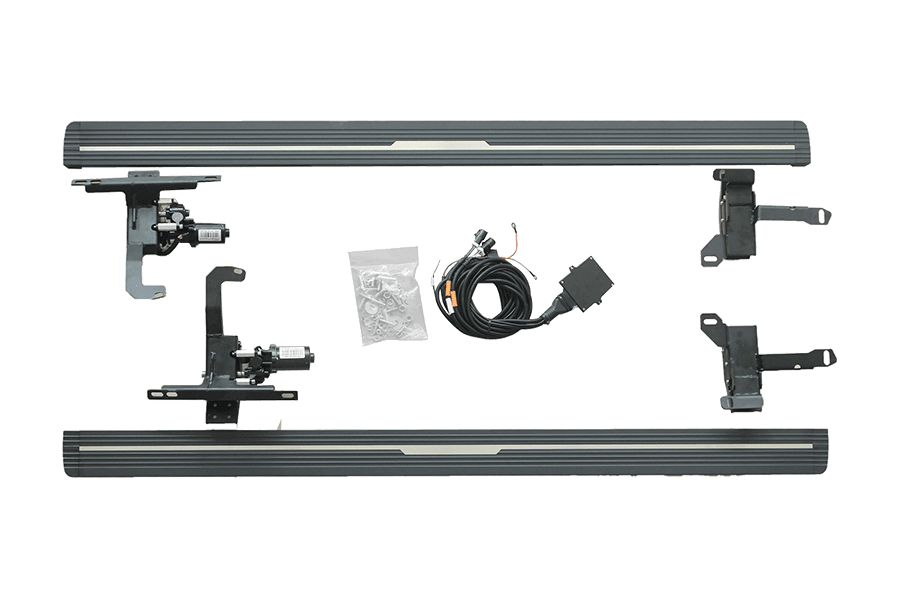
For vehicles transitioning between on-road utility and demanding off-road trails, preserving ground clearance is critical to prevent damage to expensive undercarriage components. These steps deliver necessary access while maintaining the vehicle's original approach and departure angles.
Established in 2014, our technology-based enterprise located in Huzhou, Zhejiang, specializes in addressing these medium to high-end SUV and truck accessory challenges. Our R&D managers utilize 3D scanning and FEA (Finite Element Analysis) to simulate extreme obstacle courses, validating the clearance and structural integrity of the retracted step system before entering production. This rigorous validation process supports the product's function in challenging terrains.
Application Areas
- Lifted or Modified Trucks/SUVs: Vehicles with suspension lifts where the original step-up height is too extreme, yet maximum ground clearance must be preserved off-road.
- Utility and Construction Fleets: Vehicles that frequently navigate unpaved sites, where deep ruts or debris could damage low-hanging accessories.
- Mountain and Trail Enthusiasts: End-users focused on overlanding, camping, or serious off-roading where undercarriage protection is a primary purchasing factor.
- Mining and Exploration Vehicles: Vehicles operating in environments where contact with abrasive terrain is highly likely.
Specification
| Ground Clearance Improvement (Retracted) | Minimum 30 mm above typical step mechanisms |
| Linkage Configuration | High-Tuck Parallel Linkage |
| Component Protection Rating | IP67 (Motor and ECU) |
| Bracket Material | Q345 High-Yield Strength Steel |
| Tested Ramp Angle Tolerance | Verified clearance at 25∘ ramp over articulation |
FAQ
- Q: How do these steps maintain high ground clearance if my vehicle has a body-on-frame design vs. a unibody SUV?
- A: Response: The clearance gain is achieved through vehicle-specific bracket design. For body-on-frame trucks, the brackets mount high on the frame rail, placing the retracted linkage above the rail's lower edge. For unibody SUVs, the mechanism mounts above the pinch weld line, ensuring the assembly does not drop below the vehicle's standard lowest point.
- Q: Will heavy mud or freezing conditions impact the ability of the steps to fully retract and lock in the high-tuck position?
- A: Response: The linkage arms are designed with minimal flat surface area to reduce mud retention. Furthermore, the motor system includes an over-torque stall current limit that briefly provides increased power upon retraction to break minor ice buildup or packed mud, ensuring the mechanism reaches and locks in the fully retracted position.
- Q: What specific load testing is performed to ensure the steps remain stable when used on a severe side-hill incline or uneven ground?
- A: Response: The steps undergo simulated static side-load testing where 150 kg is applied eccentrically to the step edge while the mechanism is articulated to a 15∘ angle. The test criteria require a maximum step platform deflection of less than 2 mm to ensure user stability under extreme angular conditions.


 No.42 Changhe Road, Changxing County, Zhejiang Province, China.
 +86-400-6265788